Thursday 05/16/13

10:00 A – 8:00 P, 9:00P – 12:14 A

Feducials

  • Suggestions from Ke
    1. Dual-Objective scope has a dual-pass filter to allow green beads to show through
    2. Add beads in imaging buffer (no need for washing).
    3. Try 625 beads. Spectra
    4. Use PBS with Ca[2+], Mg[2+] as imaging buffer.
    5. Ke uses MEA — fewer photons (~3800 vs 5000) but lower duty cycle (.0005 vs .0012)
  • Quick test with 625 beads
    • 625 beads may be too bright — need to compare to sample
    • Beads also do bleach, not incredibly fast and mostly in a few steps (maybe detach?)
    • Beads added in imaging buffer zip around and continue to attach during imaging.
  • work out software to do tracking based drift correction.
    feducial_drift_correction
  • check color-coded temporal traces of BX-C loci to see if drift is a likely source of dot spreading
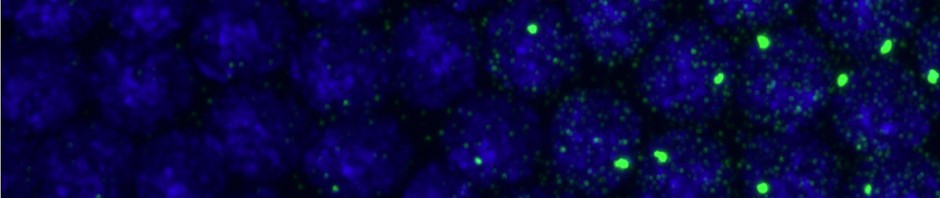
  • Not obviously extended by drift (not uni-directional at any rate). Not easy to tell though when dots are on for only ~2000 of 60,000 frames unless drift is uni-directional.

More feducial attempts

  • 625 beads on embryo coverglass. Don’t see beads, lots of single-molecule red-dye background. Maybe these ancient beads have deterioriated and released dye? don’t have contrast to see beads against bright embryo spots in conv?
  • Try 540 beads with weak yellow laser. Easier to distinguish bead-dots from nuclear dots. Don’t bleach.
  • imaging AATAT embryo

Probe making

  • Restriction enzyme should arrive today.
  • Set up nicking reactions
  • per 100 uL reaction
    1. 81 uL DNA,
    2. 10 uL buffer,
    3. 9 uL enzyme
  • AbdA, AbdB, Ubx: 324uL DNA + 40uL buffer + 36 uL enzyme
  • B, G = 162 uL DNA + 20 uL buffer + 18 uL enzyme
  • Y, K = 324 uL DNA + 40 uL buffer + 36 uL enzyme
  • ND samples before
sample ND
B EE 3650
Y EE 2591
G EE 4040
AA EE 1410
AB EE 567
AB W2 45
Ubx W2 98
  • Heating up hot-bath to run gel
  • Pre-run pre-cast 15% Urea-PAGE gel, 30 min in hot bath at 55-60C
  • Pool digest reactions
  • split large reactions into separate 200 uL volumes
  • to each 200 uL, add 4 uL glycogen, 25 uL 4M NH4Ac, and 1 mL cold EtOH
  • freeze O/N
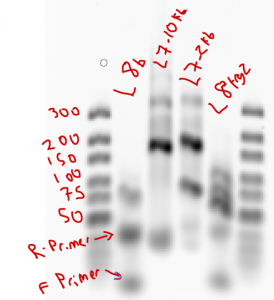
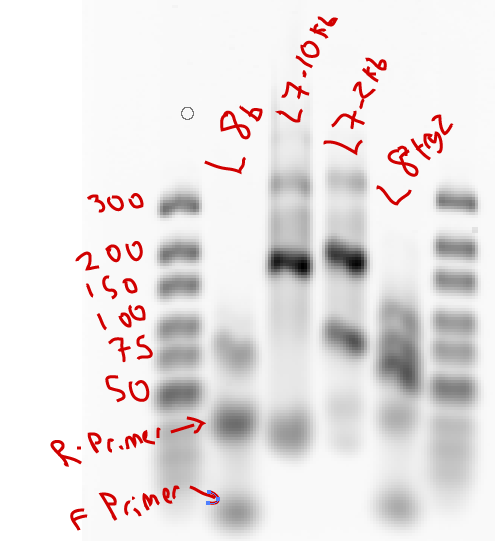
  • Gel does not look promising, only obvious difference is a broad band at <50bp in all the digest conditions. Both pre and post digest have acquired a double band, even though the denaturing gel off the PCR had only 1 band.
  • Maybe this will run cleaner after EtOH precipitation
  • though wtf what happened to the predigest…
Posted in Summaries | Comments Off

Wednesday 05/15/13

10:15 A – 7:30P, 8:30P – 12:30 A

Probe design

  • ordered new 405 oligo-probes with short attachment
  • ordered unlabeled 30 bp AATAT probes with primary extentions
  • ordered unlabeled 30 bp AATAT probes with double length primary extention to bind 32mer 405 and cy5
  • ordered 32mer NHS-ester and cy5

Clone 8 cluster analysis

  • substantially more disperse? or is this background?
  • compare S2 and clone8
    1. BX-C transcriptomics gene expression
    2. Pol II density
    3. Histone1 density and Histone3 density
    4. All tracks look very similar. Probably not different structure.
  • line is derived from L3 wing disks.
  • Definetely need in-image feducials.

STORM

  • Make PDMS box with Jeff to allow for repeated stain/image/stain cycles.
  • Trying to STORM embyro-AATAT cy5 with beads. 540/560 and 580/065 beads really only bright enough with 561 laser on, not excited by 647 laser.
  • 580 beads washed off or bleached in STORM buffer
Posted in Summaries | Comments Off

Tuesday 05/4/13

10:00 A – 5:00 P, 9:00 P — 11:45 P

Analysis of signal and background in different hybe conditions

  • Discussion with Brian on temperature results

Additional notes not yet sent:

Hybe conditions that reduce binding to reduce background seem to also lose target probes. As the number of probes goes down, one is tempted to image for longer in order to detect a higher fraction of the probes which are bound, and all during this time, waiting for these probes to give their last blinks, we are accumulating background.
In contrast, if the labeling is really high, we have much more signal in the target spot than in the background spots, so it is easy to identify and in the very small region of the target spot most of the signal will be on target binding events. For example, some of our early BXC images have >5,000 localizations per pixel in the region of the nucleus overlapping the conventional dot, and <200 localizations per pixel on average in the nucleus, which is pretty good signal to noise still (25 fold).

From our preliminary tests with the activator before, I think that may be pretty useful in further reducing background. In particular, if the off target binding events of the 405 labeled or unlabeled primary probe sequence occlude the secondary binding region when they stick to their off target partners, these guys won’t receive cy5 conjugates.

Differences in clone8 vs S2 cell hybes, sent to BB.

S2_cell_BXC

clone8_cell_BXC

Testing biobeads approach for probe making

  • see notes
  • this post also documents other approaches in the pipeline to try.

Ordering

  • Ordered T7 and RecJ
  • Carboxyl beads suddenly changed price ridiculously on the Fishcer Sci site.
  • Ordered primers for RNA synthesis
Posted in Summaries | Tagged , , | Comments Off

Protected: more probe making approaches

This post is password protected. To view it please enter your password below:

Posted in probe and plasmid building | Tagged , | Comments Off

Monday 05/13/13

9:30 A – 7:00 P, 9:35 P – 11:15 P

Post-doc candidate interview

  • see notes
  • Gheorghe Chistol (Bustamante Lab)

Presentation stuff

  • Touch up slides for post-doc candidate chats

Communication

  • Feedback from Chicago: Some support from Stats department
  • Ecology/Evolution finds “math too simple” — probably over emphasized simplicity
  • updated CV and website with recent presentations and publications
  • Sent CV to John.

OligoPaints

  • O/N 37C evaporates all ~144 uL of H2O for resuspending DNA pellet
  • resuspended DNA samples separate out into cloudy non-soluble fraction. Hopefully this is just all the protein
  • Precipitating 5 mL scale Y and K DNA
  • Resuspending Y and K DNA
  • Testing 1:20 dilutions on Agarose gel compared to original PCR at 1:10 dilutions and ladder at 1:10 dilution pre-digest_gel
  • concentrations all look low. Maybe recovery from 50 mL falcon’s not so good.

Bead based extraction prep

  • Order regents
  • PEG 8000 (soluble up to 63% in ddH2O, better in warm water 80-90C).
  • ThermoScientific magnetic beads, 15 mL

Coding

  • Finish writing SteveViewer
  • lost multicolor support
  • restored multi-mag support. Automatically downscales to save memory
Posted in Summaries | Comments Off

Protected: Gheorghe Chistol postdoc interview

This post is password protected. To view it please enter your password below:

Posted in Lab Meeting | Comments Off

Sunday 05/12/13

10:00 A — 8:00 P, 9:15 P – 11:30 P

OligoPaint Probes

new PCR

  • Pool samples: 4 mL Ubx, AbdA and AbdB, 2 mL each B, Y, K and G.
  • cooling down ultra-centrifuge (takes 3 hours, good thing to start while samples are precipitating in freezer)
  • added 16 uL glycogen to all samples, + 100 uL 4M NH4oAc per mL to each sample. Vortex
  • added 13 mL 100% cold EtOH to each 4 mL scale reaction and 7 mL to each 2 mL scale reaction
  • freezing at -80C, ~3P
  • Test gel of PCR product. (First gel ran backwards, box direction was flipped). Ran out 3 uL of a 1:10 dilution. midscale_PCR
  • Y and K don’t look good. Redoing reactions with 2x primer and 2 uL per 100 uL of PCR 1 stock (short primer amplicons at ~100ng/uL)
  • spin down in ultra-centrifuge: 14,000 xg, -3C, time = hold (~ 1 hour)
  • wash with 70% ethanol, respin.
  • Spin in swinging buckets moves pellet to bottom of the 50 mL flask, where it can be more easily resuspended. Also helps pellet stick to facilitate removal of ethanol
  • Low glycogen precipitations definetely have more fall-apart pellet (using 1/5th recommended amount in all samples).
  • let drip dry upside down ~ 3 hrs. Dries well.
  • Resuspend 4 mL scale in 488 uL of ddH2O and 2 mL scale reaction2 in 244 uL ddH2O.
  • Y and K look good this time (see on T7 gel).
  • Set up 5 mL scale of Y and K PCR to run O/N.
  • Still need to nicking enzyme to arrive from NEB.
  • B, Y and K primers are out. Should re-order sometime at the 50 ng scale.

Troubleshooting

  • Incomplete nicking: maybe nick sites are mutated in library? If PCR primers extended in to overlap the nick sites, we can should be able to correct possible mutations
  • Ordered Nicking primers including nick sites (will better match the adapter Tm anyway).

T7

  • Set up 10 uL scale reactions (1 uL T7, 1 uL NEB buffer 4, 8 uL resuspended DNA)
  • Gel *T7gel
  • Maybe worked?
    • No-PPT slowly being digested, no change to shape, intensity drops,
    • PPT being converted into single strand, runs as smear
    • Neither complete. Hard to tell, need better controls:
  • Exonuclease digestion, next steps:
  • Compare different enzymes
  • negative control PPT modified reverse primer — should be undigestable if both are PPT
  • positive control pure doublestranded DNA (no bubble library stuff).

OligoPaint Hybe optimization

  • Analyze dot intensity and background signal for 4 different hybe temperatures
  • working on summary slides (Hybe_analysis.odp)
  • BX-C looks qualitatively different in Clone8 cells

STORM observations

  • from yesterday
  • My slide tweezers got a slight spot of rust on them, and an almost invisible fleck stuck to coverslip 3, which I did not notice until the slide was sealed in epoxy. But the little bit or iron reacted with and destroyed the buffer, so while the signal looked good, none of the molecules photo-switched at all.

Ph-FLAG

  • Next round of experiments
Cell line Primaries Secondaries
wt Ph-FLAG m a-flag + rb a-Ph dk a-m 647, dk a-rb 750
wt Ph-FLAG m a-flag + rb a-Ph dk a-m 750, dk a-rb 647
M1 Ph-FLAG m a-flag + rb a-Ph dk a-m 647, dk a-rb 750
M1 Ph-FLAG m a-flag + rb a-Ph dk a-m 750, dk a-rb 647
S2 cells rb a-Ph dk a-rb 647
Posted in Summaries | Comments Off

Saturday 05/11/13

3:00 P – 8:00 P, 9:30 P – 11:15 P

Kinetic modeling

  • Discussion with Jeff
  • sent text books (see email)
  • Lent library book (Feller) to Jeff
  • should write text together?

OligoPaint Probe making

  • spin down ethanol precipitating samples of probe cut from gel
  • Also spin down PPT protected and non-protected samples
  • Resuspend in 20 uL ddH2O

Problem solved?

  • Used short forward instead of short reverse primer in making B/Y/K/G probes.
  • Repeating at 2 mL scale with correct probes. Will test on gel tomorrow

Restart Ubx, AbdA. AbdB

  • 4 mL scale each
  • new dNTPs, fresh Taq,
  • In total ~17 mL of PCR (24 + 33)

Data storage:

12 TB system:

Mediasonic HFR2-ASU3S2 SmartShield 4 Bay External Hard Drive Enclosure Amazon

4x Western Digital Caviar Green 3 TB SATA III 64 MB Cache Bare/OEM Desktop Hard Drive – WD30EZRX Amazon $ 130 each

Total: $713.00 Capacity: 12 Tb RAID Capacity: 9 Tb

24 TB system:

Mediasonic H8R2-SU3S2 ProRaid 8 Bay External Hard Drive Enclosure – USB 3.0 & eSATA (Black) Amazon $350

8x Western Digital Caviar Green 3 TB SATA III 64 MB Cache Bare/OEM Desktop Hard Drive – WD30EZRX Amazon $ 130 each

Total: $ 1398 Total storage: 24 Tb (58.25 per Tb) . RAID Capacity: 21 Tb

Posted in Summaries | Tagged , | Comments Off

Friday 05/10/13

9:00 A – 10:33 P

OligoPaint Probe making

  • Spin down crushed gels and aspirate fluid.
  • Attempt to nanodrop. ~200/UV peak, readings probably meaningless. Could Qubit but hopefully these are single-stranded now and shouldn’t read.

nanodrop

  • no 260 peak, so reading maybe useless, strong 200 peak.
  • U short: 5
  • U long: 11
  • AB short*: 7 (has loading dye as well)
  • AB long: 9
  • O/N PCR of PPT and CPPT finished
  • Pour gel
  • Gel results: PPT_gel2

To Do

Computer

  • Consolidated Ph Data on to Alistair11.
  • Cleared all data off of Alistair13, can go back to being mobile drive
  • Moving en-emb to Alistair10 from Alistair12.

STORM analysis

  • Insight batch analysis gives error cannot save configuration file… but still seems to run.
  • Insight is not in fact analyzing correctly — list.bin file has only one molecule per frame instead of all the ones fit by the parameter choice.
  • Insight parameter no-Z fit seems to lead to screwed up mlists output STORMfinderBeta
  • Alistair9 spooling to Cajal has trouble running more than 4 version of Insight at once.
  • ReadDaxBeta for bypass mode is grabbing the wrong image bits, but ReadDax gets the right ones…

Project 2 analysis

Posted in Summaries | Comments Off

Protected: project 2 update

This post is password protected. To view it please enter your password below:

Posted in Summaries | Comments Off